Pages

Words for a Stronger Marriage

What are some words of wisdom for a better marriage? 

THERE ARE LOTS!

The first place to start is the Bible! The best wisdom of all!

But sometimes we need guidance in how to apply what we read in the Bible. The following list is a good place to start. The list is not all inclusive and is in no particular order - there are more good, Christian marriage books out there.

For a long lasting marriage, try to do something once a year to strengthen your marriage - like reading a book together.

The important part is to read and apply!

Us In Mind: How Changing Your Thoughts Can Change Your Marriage by Ted Lowe

Love and Respect by Emerson Eggerichs

10 Great Dates to energize your marriage by David and Claudia Arp

$10 Great Dates: Connecting Love, Marriage, and Fun on a Budget By Larsons and Arps

101 Conversation Starters for Couples by Gary Chapman

Master Your Money by Ron Blue

Managing God's Money: A Biblical Guide by Randy Alcorn

A Lasting Promise by Scott Stanley and others (good on communication)

The Dangerous Duty of Delight by John Piper (not just on marriage but is a great, short book about our relationship with the Lord and how it affects different areas, and has a great chapter on marriage)

For Men Only by Shaunti Feldhahn

For Women Only by Shaunti Feldhahn

The 5 Love Languages by Gary Chapman

Staying Close by Dennis Rainey

Sacred Marriage by Gary Thomas

When Two Become One: Enhancing Sexual Intimacy in Marriage by Christopher and Rachel McCluskey

Anything by Gary Rosberg


Observations on Marriage, part 2

We have been involved in strengthening marriages and crisis marriage ministry for 35+ years. Through the years, some common factors (not all inclusive) stand out to us. [see part 1 here]

1. Not having realistic expectations of marriage. 

Most people expect marriage to make them happy.

When they experience unhappy days, they think something is wrong with their marriage. 

SOLUTION As we grow up, we all formulate ideas about what will make us happy. If we marry, we usually think marriage will make us happy. 

Happiness is based on circumstances that can change daily. 

Instead of looking at the circumstances of our marriage as markers of happiness, we can find a lasting joy in our relationship with the Lord and, consequently, in seeing joy in our spouse.

The precepts of the Lord are right, giving joy to the heart. The commands of the Lord are radiant, giving light to the eyes. Psalm 19:8

2. Not having realistic expectations of their spouse.

It has been said that a husband thinks their wife will never change (especially in their physical beauty) and a wife thinks that they can change their husband (especially in their habits).

Consequently, both are disappointed. 

SOLUTION Our expectations of our spouse are usually not voiced. When our spouse doesn’t meet expectations, we are disappointed or angry and our spouse doesn't know why.

 Sometimes we base those expectations on what our father or mother was like or ideas we get from romantic movies or books. 

Instead of holding our spouse to unrealistic expectations, we release the expectation and value our spouse as he or she is.
 
3. Not understanding what unconditional love is. Most people go into marriage thinking that nothing will change their love for their spouse. But many have never experienced unconditional love; they have not seen examples of it.

But when we feel hurt by our spouse, our love begins to dissolve. If allowed to continue, we don’t “feel loved” or “in love” anymore. 

SOLUTION Unconditional love means I love that person no matter what they do. 


It does not mean that I agree with what my spouse does or that I don’t confront my spouse. But I love that person as God loves me! Love one another. As I have loved you, so you must love one another. John 13:34

As I receive God's love, I can give my spouse love out of the overflow of my heart - not expecting anything in return. We all want to be loved that way, but we also need to love that way.

4. Lack of forgiveness for the hurts. We cannot truly love unconditionally without forgiving.

Instead of forgiving, we seek to pay them back for the hurt by withdrawing or saying hurtful words back. 

SOLUTION Forgiveness is ESSENTIAL to a lasting marriage

Forgiveness means that I don’t pay back the person for the hurt they cause me, that I don’t keep bringing it up and that I don’t dwell on it. It doesn’t mean that we don’t confront the sin or express how we feel. 

I can forgive as I receive and understand the depth of God's forgiveness. If God forgives the sin, who am I not to forgive the hurt? In the same way God has forgiven me, I can forgive others. 
Be kind and compassionate to one another, forgiving each other, just as in Christ God forgave you. Ephesians 4:32

5. Not showing respect. We often believe that a person has to earn our respect before we treat them with respect.

Often, we don’t really know what our spouse really thinks or feels about respect. 

SOLUTION God calls us to respect all people, including our spouse. We  show respect to them because they are a human being, not because of what they have done. We show respect also to our spouse because of our commitment to the marriage. Show proper respect to everyone. 1 Peter 2:17


Respect means different things to different people but includes the way we speak (not degrading or disdainful), the value we show to their opinions and ideas, and not trying to change them (show that we value who they are). Ask your spouse what you can do to show them respect.

6. Competitiveness. Competitiveness comes in many forms - from who is right and who is wrong to who earns the most money. 

SOLUTION Competitiveness can be good in sports or debates. But it can also lead people to be aggressive or antagonistic if their decisions or opinions are questioned. If I am competitive in a relationship, I have a compulsion to be right, not considering that I could be wrong. 


Being willing to admit that I am wrong is the first step to eliminating that tension from the marriage. Realizing that there is more than one right way to do things is extremely important in marriage. Giving your spouse the freedom to do things their way or to have a valid opposing opinion brings closeness.

7. Not working as a team. When we don’t agree on how to spend money, discipline the children, etc., we work against the other or go behind their back. 

SOLUTION Your spouse is not your enemy. Satan is the enemy who is seeking to fracture marriages. 

Working together as cooperative teammates can defeat the enemy and preserve your marriage.

8. Escalating the tone of a disagreement.

When there is a disagreement, we respond in a way that takes the emotions a notch higher. Then the other person does the same until the situation is out of control. 

SOLUTION In a conflict, seek to bring the emotional level lower through calm and thoughtful responses, while listening to your mate. If the emotional level escalates, call a time-out to let the emotional level come down. They return to the subject calmly and thoughtfully, seeking to understand your mate's point of view.
A gentle answer turns away wrath, but a harsh word stirs up anger. Proverbs 15:1

9. Not resolving conflicts. When conflict arises, some people withdraw or shut down and some get angry and attack. Then they abandon the issue and nothing is resolved.

If we can’t resolve the small issues, we will find it hard to resolve the large ones. Then, even the small issues can become large. 

SOLUTION So many of us never learned conflict resolution in our home or in school. Resolving conflict includes talking about an issue calmly and respectfully. We look at what is important to each person in an issue and seek to find a solution that can be a win-win. 

If unsuccessful, seek guidance from a godly third party.

If it is possible, as far as it depends on you, live at peace with everyone. Romans 12:18

For a downloadable version, click here.


Observations about Marriage - the Problems & Solutions

We have been involved in strengthening marriages and crisis marriage ministry for 35+ years.  Through the years, some common factors (not all inclusive) stand out to us. [printable version]


1. The number one problem in marriage is selfishness. 
    My selfishness is directed towards getting my needs met in my spouse - to feel loved, valued, respected, secure. Since my spouse can't meet enough of my needs, I am unhappy.

      SOLUTION The only lasting solution to the problem of selfishness is to seek God to meet the needs of my life. He is the only one who can satisfy me. Your spouse isn't capable of meeting all of your needs, they aren't intended to. When I allow God to meet my needs, I can give to my spouse without expecting anything in return – the essence of unconditional love. Love one another. As I have loved you, so you must love one another. (John 13:34)

2. Dissatisfaction in marriage.
    Every couple has conflicts at some time. Without commitment, dissatisfaction can lead to separation and divorce.

    If I think that other marriages are happier than mine, or that every husband/wife is better, I haven’t lived in their home or known the inner workings of what is happening between them. There is no such thing as a perfect spouse or marriage. 

     SOLUTION I will not compare my wife, husband, or marriage to others. Other people are not the same as we are and do not have the same life circumstances that we do. We are committed to resolving our difference. There is no plan B. We will not say the word “divorce” in regards to our own marriage.
When a man makes a vow to the Lord or takes an oath to obligate himself by a pledge, he must not break his word but must do everything he said. (Numbers 30:2)

3. Crisis counseling
    It is much easier to help a couple who have been married 5 years or less, regardless of the problem, than to help a couple married over 25 years.

    The longer a couple is married without resolving problems, the more entrenched most couples are in bad habit patterns, wrong beliefs, or unhealthy interactions. 

     SOLUTION When we hit a bump in the road of our marriage, We will seek guidance from a mature, objective, Godly person or couple. We won’t involve family or close friends. If my spouse won’t go with me, I will seek help for my part.  Let the wise listen and add to their learning, and let the discerning get guidance. (Proverbs 1:5)

4. Being UNWILLING to look at my own life in an effort to improve my marriage.
I think my spouse is the problem - he/she needs to change. 

     SOLUTION I will be teachable to make progress in my marriage. I will seek help. I am willing to see what God wants to change in me. One person can change the climate of a marriage! I  can’t change my spouse. The real issue is my response. I can only change my response to the person or the situation.
 The way of fools seems right to them, but the wise listen to advice. 
(Proverbs 12:15)

5. Our differences drive us apart.
A warning - “Before marriage opposites attract. After marriage, opposites attack.” 

     SOLUTION I will value and appreciate our differences. Those personality habits, abilities, and talents can become attributes that bring strength to the marriage. When I see differences as a negative, those differences drive us apart instead of bringing us closer. The key is to see my spouse’s strengths that complement and complete me. 
All believers are part of the body of Christ. We are all different, but all are valuable. (1 Corinthians 12)
  
6. As soon as I begin to focus on what is missing in my spouse, conflict begins.
My human tendency is to compare myself with others who have more than I do, not with those who have less than I do. In all of life, ingratitude brings dissatisfaction and, eventually, anger and even depression. 

     SOLUTION I will focus on the positive attributes of my spouse. I will make a list of all of the her/his good points and read over it regularly. I will thank God for the good in my spouse and in my marriage. 
Give thanks in all circumstances; for this is God’s will for you in Christ Jesus. 1 Thessalonians 5:18

7. Couples in distress have not learned how to disagree agreeably. They only argue. 

The arguments escalate and are never talked through or resolved, which causes more resentment in the relationship. 

     SOLUTION Disagreeing means that I listen respectfully to other’s opinions, whether I agree or not. But arguing is trying to prove that I am right and the other person is wrong. I can agree to disagree on points that are not essential. Realize that there are some issues that we will never agree on. If the emotions start to get more intense, we will take a time-out to cool off. Then we will come back together and talk respectfully to each other. 
Show proper respect to everyone. 1 Peter 2:17

8. Not listening! 
When I am formulating an answer while the other person is talking, I am not listening. Without listening, beneficial communication is not happening. Interrupting negates listening. 

     SOLUTION Listen! Listen! Listen! Listen to the heart, not just the words. Make listening a priority, even if the topic is not interesting to me. What others say is important to me because it is important to them. To answer before listening— that is folly and shame. (Proverbs 18:13)

9. Couples quit having fun in their marriage. 
We came together because we enjoyed being together. But the stresses of life have made our marriage miserable. 

     SOLUTION Take time to be together doing something enjoyable - not talk of stressful topics, no kids, only us. Weekly date nights can preserve the fun in marriage. A yearly getaway can revive the relationship. Remember to have fun!

10. Hiding things or working against each other can destroy a marriage.
We are not being open and honest with each other when we hide what we do with our money or who we talk to or text. We destroy trust in the relationship. 

     SOLUTION Be open and transparent with each other. Be willing to let your spouse see your phone , your computer, social media - who you talk to, text, or email. Do not hide income or expenditures. Have joint accounts or transparency with accounts. Learn to work as a team to solve problems. 


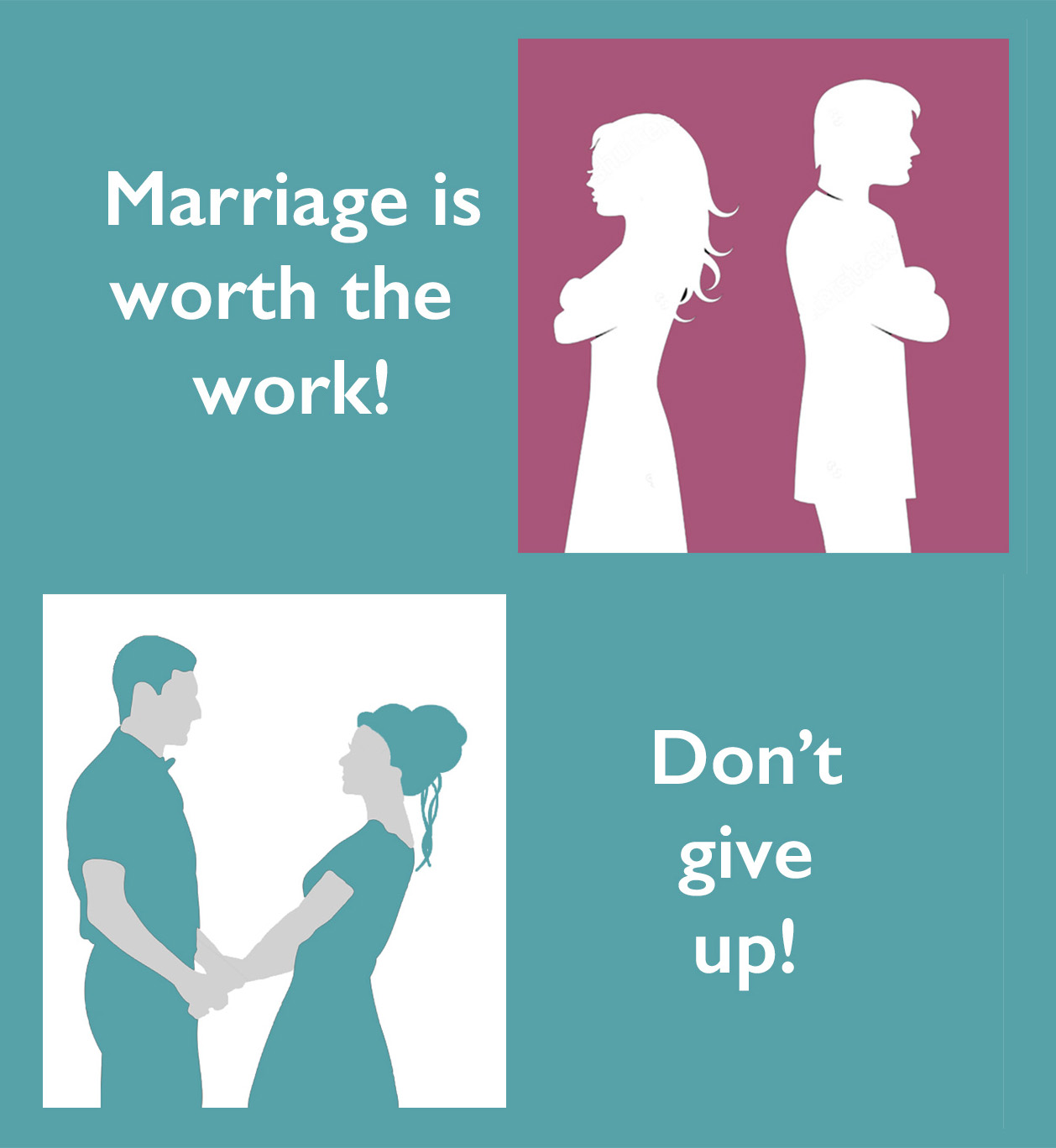
Marriage is worth the work! Don’t give up!

Encouraging Marriages*

*Not intended to be all inclusive. [printable version of this page]

WHERE TO START


Many of us believe that if a couple is attending church and loves God that they will have a successful marriage.

How many of us know couples that fit that criteria but are unhappy in their marriage, even miserable? Or divorce?

The couple often leaves their church as their marriage disintegrates. They don’t want to have to talk about it or explain it.

Maybe it’s a friend or colleague and we see that there is a lot of tension in their marriage.

What do we do?

We start with our own marriage. We don’t need to have a perfect marriage (who does?) to encourage another couple.

  • We are committed to working out difficulties and strengthening our own marriage. We learn what it takes and what works/doesn’t work. 
  • We are transparent about our struggles. Doesn’t mean that we air all the details, but we let our friends, church circle, colleagues know that we have had struggles but have overcome them. People need hope! Couples often think that others have it all together and wouldn’t understand. 
  • We are willing to walk alongside others in kindness and compassion. It may mean taking the initiative to inquire about their life and their marriage.
TRUST

Others will be open to what we say if they trust us. They trust that:
  1. We believe what we say, because they have seen us demonstrate it. See above.
  2. We will share truth - not what social media or the latest TV guru says.
  3. We care about them. We want the best for them and we aren’t going to abandon them because they are struggling.
  4. We will keep their words confidential.
  5. We will not judge, condemn or attack them. We won’t think less of them because of their problems.
    Accept one another, then, just as Christ accepted you, in order to bring praise to God. Romans 15:7


WHAT CAN THE CHURCH DO?

Does the Church have a role in helping marriages in distress?

YES! The Bible addresses marriage in several places and compares it to Christ and the Church. Marriage is important to God. So, it is important to the Church.

Traditionally, church was one of the places where couples sought help when their marriage was struggling. That has changed some, but is still important.

Helping marriages can be messy. Being preemptive can reduce the occurrences of troubled marriages.

PREEMPTIVE steps can include:

    • Premarital counseling/classes, with a premarital assessment. 
    • Marriage classes offered regularly during the weekly small group time (at least once a year), or during a separate discipleship time (with childcare). 
    • Making marriage resources easily available - can include books, booklets, online and in printed form. 
    • During bible teaching times (from the pulpit or in classes), apply appropriate passages to marriage. 
    • Emphasis within the culture of the church that marriages are important. We care and we are available. 
    • Find mentors for new couples. 
    • Small groups for couples at the same stage of life, providing positive peer pressure. 

 ONGOING

If you suspect that a marriage may be struggling, the church can seek to help bring healing by:

    • If you see something, say something. Individuals can reach out to the couple, the wife or the husband. Meet for coffee to see how they are doing. LISTEN! Offer support and share personal experience, if appropriate. 
    • Marriage counseling, either by trained pastoral staff or a marriage counselor, or referral to a counselor (the church may supplement cost). 
    • Pray for them and with them!
AVOID
  • Talking without listening. People want/need to be heard. Listening shows we care. 
  • Giving pat answers. Not everyone needs the same solution. A pat answer oversimplifies the problem. 
  • Being judgmental. Regardless of the validity of a person’s perspective, they do not need us to bluntly tell them they are wrong. We shut the door on further conversations if we come across as judgmental. 
  • Sending a person back to a dangerous situation! Help find a safe solution. 
  • Taking sides. We can sympathize with one or both but we need to be an advocate of marriage, not a person. Every conflict has two sides. We may not know the whole story. 
  • Do not advocate FOR or AGAINST divorce. That is each person’s decision. 
  • Don’t promise outcomes. Help them see solutions or different options, but give hope. Many people have two bad options to choose from. They can follow a path that God gives but they can’t control the outcome. 

DON’T AVOID THE PERSON!


For a printable version of this page, click here.


Give Thanks

The Power of Thanks

As children most of us are taught to say thank you. Children often look at it as a chore, something parents demand, rather than a condition of their heart.

A meaningful “thank you” comes from a heart of gratitude. We teach our children to say “thank you” even for a gift that they really don’t want or an action about which they don’t care.

We can always tell when a “thank you” doesn’t sound sincere. But a sincere “Thank you!” brings delight to our soul.

From a study at UNC-Chapel Hill, “Researchers studying gratitude have found that being thankful and expressing it to others is good for our health and happiness. Not only does it feel good, it also helps us build trust and closer bonds with the people around us.

Now, a new study suggests that expressing gratitude not only improves one-on-one relationships, but could bring entire groups together—inspiring a desire to help and connect in people who simply witness an act of gratitude.”

As people witness expressions of gratitude, they think more highly of the person giving as well as the person receiving it. They are are attracted to working with these people and they are more likely to express appreciation as well.

Why it’s important ……

Making gratitude and giving thanks (to God and to others) forces us to look for the good in our lives.

As humans, our natural tendency is to see that negative around us. But when we are focused on the good, we are less focused on the negative.

We also are forced to acknowledge that others are involved in our well-being. This attitude moves pride aside. We thank God for who He made us to be - our healthy bodies, our intellect, our unique gifts and talents.

We can train ourselves to focus on the good in our lives. We can teach our children to make that a part of their character. When gratitude becomes a habit, it is expressed sincerely and often.

An unknown author once said, “The things we take for granted are dreams to many people.”

What do we take for granted but are prized by others? Are we thankful for them?

When is that last time we thanked God for them?

How and When ….

Does is matter how we express our gratitude?

An expression of thanks in any form is better than none at all. To be effective, be specific about what you are thanking the person - thank you for doing the dishes ….. thank you for the gift card that you gave me for my birthday . . . . thank you for working so hard.

The thanks will have even more impact if you express it publicly. For example, express the sentiment in front of your husband and friends, I am so thankful that my husband took such good care of me while I was sick.

A hand-written thank you note has become a rare treat since that presence of emails and text messages. Because of their rarity, they have even more impact.

In my (Donna’s) first job out of college, my employer would thank me when they handed me my paycheck. I was shocked! I had never experienced that before or heard of it. That expression of thanks for my work went a long way in how I felt about my employment. And I have never forgotten it.

Do we need to thank someone for doing their job - whether it is thanking an employee or a wife for what she does for the family or the husband for providing for the family (or vice versa)?

Expressing gratitude to our spouse for “doing their part” or for the more menial tasks makes them feel loved and appreciated.

In her research about marriage, Shaunti Feldhahn found that husbands feel more loved when their wife tells them “thank you for ….” than from saying “I love you” to them.

Her research shows that 79% of men in highly happy marriages say that it deeply pleases them when “She notices when I do something and sincerely thanks me for it.”

Even if one person in a relationship (marriage, parents, workplace) implements sincere gratitude, it changes the environment for the better.

Consider ….

Ingratitude can be a very destructive state of mind.

Ingratitude is so focused on what I don’t have or unmet expectations in my life to the exclusion of all of the good that God has given me. Every good thing given and every perfect gift is from above, coming down from the Father. (James 1:17)

Ingratitude leads to anger, bitterness, and even depression. A lack of gratitude erodes relationships.

Why are people ungrateful?

There can be many roots to the fruit of ingratitude. They can include: an expectant attitude, a demanding spirit, selfishness or self-centeredness, and pride.

A proud man is seldom a grateful man, for he never thinks he gets as much as he deserves. Henry Ward Beecher

Gratitude changes everything.

Gratitude can transform common days into thanksgivings, turn routine jobs into joy, and change ordinary opportunities into blessings. William Arthur Ward

Can my marriage change?

 YES!

After counseling hundred of couples and/or individuals who are married, we have seen that marriages CAN change, even if only one person is trying to improve their marriage.*

We have observed the change that takes place both in our own marriage and that of many others. While we knew what worked for us, what works for others may be different. But we are happy to say that someone did research on this phenomenon! Shaunti Feldhahn discovered the important elements of a highly successful marriages. [see the research here]

How many marriages are actually happy? 

Contrary to what you may hear, the research shows that 77% of all couples say that are "highly happy" or "mostly happy!"

You have heard the phrase "Don't sweat the small stuff." It turns out that the "small stuff" can make a huge difference in marriage!

As Shaunti points out, for change to come about, we need to study the bright spots in marriage, not just the problems.

In struggling marriages, their perspective on how their spouse feels may vary greatly from how their spouse truly feels. 

In response to the statement, “Even in the middle of a painful argument, I know that my spouse is fully ‘for me’ and deeply cares about me," 41% of struggling couples disagree with that sentence. In highly happy couples, 96% agree with that statement. But the percent "who care about their spouses and want the best for them, even during painful times," 80% of struggling couples agree with that statement. 

A huge gap exists between the reality and the perception of how a spouse feels in a struggling marriage. 

Marriages that change find ways to change that perception. 

Learn more about the ways that couples can change their marriage in our next blog!

*One caveat - one person cannot save the marriage alone if the other one chooses to leave.

Work-from-home Marriage

Together …. all the time


We married to be together forever.
Did we have any idea it would include together 24/7?

During our current pandemic, everything has changed. We have all had adjustments and disappointments. 

Our daughter eagerly anticipated her wedding for over a year. None of us knew her wedding would look completely different than planned. Some have missed graduations, trips, or other special occassions.

We feel for everyone who works from home, along with their spouse, and children.

For many families, it has been a blessing to have that much time together. For others, it is a time of high stress and anxiety.

Financial and/or employment changes pile more stress on top. Forced separation from older parents or other family members strain the emotions. A change in schedule and routine throw us off balance. We might feel confused or a lack of direction in general in our lives. Our coping skills are stretched.

Whatever irritations or conflicts that were already present in a marriage are magnified in the togetherness experienced every day.

Younger couples are still learning to be compatible. For older couples, we have learned more about how to live in the constant closeness.

How do we make it when togetherness causes stress and conflict? 

We are in this Together ……

Is anyone else tired of hearing that phrase?

It is such an odd phrase when the reality is that we are not together with many others. The intent is that we are all experiencing the same thing right now…. around the world.

Few of us have seen anything that brought the whole world to its knees. The futility in the power of humans is on display. How many of us are directing our utter helplessness to God?

The Lord knows all human plans; He knows that they are futile.
Psalm 94:11

The Lord is my strength and my shield; my heart trusts in Him, and He helps me. My heart leaps for joy, and with my song I praise Him.
Psalm 28:7

The Spirit helps us in our weakness. We do not know what we ought to pray for, but the Spirit himself intercedes for us through wordless groans.  
Romans 8:26


Better Together ….

Going through a crisis together can actually strengthen a marriage . . . . when a couple works together instead of directing their anxiety, anger, or frustration at their spouse. We WILL face a worse crisis than the one we are going through right now. Now is the time to learn to work together.

Our current circumstance requires adaptations that may be new for us. 
Consider these:
  • Show the same grace and understanding that I want others to show me. We all have irritating habits. I want my spouse to overlook my habits. I can overlook his. 
  • Have fun. For those who work from home, it may be harder to find a cutoff time for work. It’s critical to take time for fun together right now! We may have to find some new ways to have fun since typical venues may be closed. 
  • Remember why we married each other. Reminisce about our days of dating and the highlights of our marriage. 
  • Take time to be apart. Give each other some space. She may need to go somewhere alone and read. He may need to work out. We all need time alone to diffuse, regroup, and refresh. To be better together, I have to be better personally. 
  • Get outside and get exercise. Go for a walk or bike ride. Try a kayak or a canoe. Get fresh air and some exercise - they reduce stress and release happy hormones in our brains. 
  • Set a schedule but be flexible. Most of us thought this wouldn’t last long and didn’t think about a different lifestyle long-term. 
  • If you need to talk through a conflict, schedule a time. Don’t have the conflict in front of the kids or at a time that it will disrupt work. 
  • Spend time meditating on the Lord and His goodness! Make a list of who He is, what He has done for you, and the blessings that He has given you. Express your gratitude to Him everyday!

Resolve ….

Your success and happiness lies in you. Resolve to keep happy, and your joy and you shall form an invincible host against difficulties.
Helen Keller

I have to come to grips with the fact that another person is not responsible for my happiness.

Most people aren’t able to just say “I am going to be happy.” But ALL of us can decide where to put our focus. I can choose which thoughts that I allow to linger and grow.

My perspective on this pandemic determines whether I look at it with joy or disdain.

If I focus on what I have missed (weddings, graduations, travel, events), my heart will be heavy.

If I focus on all that I still have (family, friends, a home to live in, food to eat, extra free time), my heart will soar.

If I focus on what my spouse does that I don’t like, I will become angry and resentful. If I focus on the good in my spouse, I will be gracious and joyful.

I can resolve to focus on good.

Whatever is true, whatever is noble, whatever is right, whatever is pure, whatever is lovely, whatever is admirable—if anything is excellent or praiseworthy—think about such things. Philippians 4:8

Are you grace-full and grace-filled?

Full of Grace ….
“Saving Grace”
“Amazing Grace”
“Fall from Grace”
“Say Grace”
“In Good Graces”
“By the Grace of God”


GRACE is a word that adorns many situations.

What does GRACE really mean?

Some dictionary definitions include:
  • unmerited divine assistance given to humans for their regeneration or sanctification 
  • a virtue coming from God 
  • sanctification enjoyed through divine assistance 
  • disposition to or an act or instance of kindness, courtesy, or clemency 
  • a special favor 
  • a charming or attractive trait or characteristic 
When we talk about a person who is “graceful” - we are usually talking more about their physical attributes than their character.

But what about people who are full of grace?

How do you describe that person?

A person who displays grace is the person that understands and recognizes God’s grace in their life. [see below]


Grace-full is a person who is not judgmental, who knows that we all need acceptance and understanding, and who extends love and kindness when we mess up. A grace-full person is a grace-filled person.


State of Grace ……
The ultimate test of our spirituality is the measure of our amazement at the grace of God. Martin Lloyd-Jones

Grace is getting what I don’t deserve. It is based on God’s mercy, not my merit.

Christians live every day by the grace of God. I am saved by grace. For by grace you have been saved through faith; and that not of yourselves, it is the gift of God; not as a result of works, so that no one may boast.
Ephesians 2:8-9

I grow in grace. 
… but grow in the grace and knowledge of our Lord and Savior Jesus Christ.
2 Peter 2:18

God’s grace is enough for all that I encounter in life. 
My grace is sufficient for you, for my power is made perfect in weakness.
2 Corinthians 12:9 

And God is able to make all grace abound to you, so that always having all sufficiency in everything, you may have an abundance for every good deed.
2 Corinthians 9:8

God gave me a spiritual gift by grace. 
We have different gifts, according to the grace given to each of us.
Romans 12:6

Good Grace ….
Evidence we really understand God’s grace will be seen in our desire and ability to show God’s grace. Randy Alcorn

Grace is a defining characteristic of Christians. It is the basis of our faith, our forgiveness. No other religion includes receiving something you don’t deserve.

Yet, many Christians find it hard to exhibit grace. The other person’s sin is so much greater, worse, more hurtful than my sin. I may compare the life of another to others but more often, I will compare it to an ideal, to what I think it should be.

We all want grace, but we cannot enjoy grace when there is an attitude of comparing. Jerry Bridges

We all want grace shown to us. But to show it to others, we must really understand the full extent of God’s grace. How little we deserve, but how much we are given. 

Some people don’t have a box to put that in. That can’t conceive of the magnitude of grace because they have never experienced it. I can bring another to a place of receiving God’s grace when I show them grace. 

Grace looks like forgiveness and acceptance. We have to experience the healing power of God’s grace to be grace-filled.

Look after each other so that none of you fails to receive the grace of God. 
Hebrews 12:15 (NLT)

God's grace takes various forms . . . grace is far more than "niceness." It's a powerful force, the force of forgiveness and reconciliation and transformation. . . For me, the goal in each case is to begin to see others through what I call "grace-healed eyes.”   Philip Yancey

Amazing Grace ….
The meaning of life. The wasted years of life. The poor choices of life. God answers the mess of life with one word: ‘grace.'
Max Lucado

Issac Newton wrote the hymn, Amazing Grace, as a testimony to his own experience of with God. God met him in a storm and his life changed. The hymn was a reflection of his spiritual growth and love for the Lord. That hymn has become one of the most recognized songs in America. It has brought healing, encouragement, and tears to many. It is estimated that the song is performed at least 10 million times annually.

As each of us looks at the many messes of our own lives and compare it to the never ending love of God, we too are amazed at His grace.

The grace of God is dangerous. It's lavish, excessive, outrageous, and scandalous. God's grace is ridiculously inclusive. Apparently God doesn't care who He loves. He is not very careful about the people He calls His friends or the people He calls His Church.  Mike Yaconelli


CLOSING the GAP

Turn towards - Turn away ….
What happens when a distance grows between us?

How did we get to this place?


Every marriage has times when we feel a distance between us.
Those times can be momentary. When the distance goes on for extended times, a red flag is waving!

As they say in the U.K., “Mind the gap!”

One or both partners withdraw for many reasons.

For example:
  • My spouse said something that hurt my feelings. 
  • I decide to punish my spouse for their words or behavior. 
  • I don’t feel safe, afraid of criticism or being ridiculed. 
  • I don’t feel my spouse cares about me. 
  • I don’t think my spouse values what I have to say, so I won’t try to talk to him/her. 
  • I don’t think my spouse is interested in what I have to say. 
  • My spouse shuts me down when I try to have a conversation. 
When any of these occur, I have to decide what to do …. my decision can close or widen the gap.

Am I going to turn towards my spouse or turn away?


It takes compassion, courage, forgiveness, and God’s love to turn towards your spouse to close the gap between you. [See more below]

God Talk ……
When love is felt,
the message is heard.
Jim Vaus

Small cracks in communication create gaps in our relationships.

God gives us much guidance on healthy communication. These skills are crucial to every successful relationship - with family, friends, and in business. And they can be learned!

Approach the conversation in humility. Show that you value the other person. Do nothing out of selfish ambition or vain conceit. Rather, in humility value others above yourselves, not looking to your own interests but each of you to the interests of the others.  Philippians 2:3-4 

Listen to the heart of the other person. Everyone should be quick to listen, slow to speak and slow to become angry.  James 1:19 

Strengthen others with your word, rather than attacking. Do not let any unwholesome talk come out of your mouths, but only what is helpful for building others up according to their needs, that it may benefit those who listen.  Ephesians 4:29

Good Turn ….
Let’s close the gap!

Instead of turning away - here are some ideas to turn towards each other.

The little things count big time! In every day conversation, I have multiple chances to turn towards my spouse. It can be something as small as one saying, “It’s a beautiful day outside.” They haven’t asked for a response. But a response shows I am listening and I care. I can ignore it (worse than turning away). I can disagree (at least they know I am listening). Best of all, I can affirm what they say - turn towards.

When one person withdraws because of hurt feelings or anger, I can give them space but pursue reconciliation. I can ask if we can discuss it later, after we both have had time to process what happened.

It’s critical that the withdrawer agree to a later conversation. If they don’t, that usually indicates a desire to punish, not reconcile.

Another aspect of closing the gap is making sure that there is a sense of safety in their communication. That safety comes from a commitment not to ridicule, criticize, curse, name-call, or degrade each other.

Turning towards each other means, that when my partner speaks, I LISTEN. Either I stop what I am doing and look at my spouse, or I say, “I would really like to listen to what you are saying, can you hold that thought just a minute, while I finish up this ….?”

When I do listen, it’s important to listen to the heart, not just the words. If my spouse says, “I don’t want to go out tonight,” what is on their mind? I may be offended and assume that they don’t want to spend time with me. But if I listen with my heart, I ask a follow up questions. It may be that my spouse is concerned about finances or is too tired or is worried about something at work.

I listen with compassion, not defensiveness. I am willing to listen, not argue with their perspective. I can turn towards them, even in disagreement.

The Cycle ….
Regardless of the reason for one person to withdraw, a common cycle is for the other one to pursue when the first one withdraws.

That pursuit causes more withdrawal . . . . . and more pursuit.


Someone has to end the cycle! The pursuer can ask for the matter to be discussed at a time that is mutually agreeable.

Or the withdrawer can ask for some time to process what happened and agree on a time to re-visit the matter.

Avoid two destructive solutions -
1) continue the cycle or
2) both withdraw.

To continue the cycle will bring anger and resentment. To mutually withdraw brings a widening gap.

Emotional Intimacy

Our souls crave intimacy. Erwin McManus
The longing for someone to know my innermost thoughts or feelings and still love and accept me resides deep in the heart of every person.

Real emotional intimacy is when I can share my deepest thoughts and feelings with another person AND that person can do that with me.

We do not share our deepest thoughts and feelings with everyone. We are willing to share some thoughts with acquaintances or strangers. We will share more thoughts and feelings with friends.

But we only share very personal thoughts and feelings with close friends, family, or a spouse.

To share on that very personal level, the relationship must have a high level of trust.

When I trust that person, I believe that what I have said won’t be shared with other people and it won’t be used against me. It means that my thoughts and feelings will be valued. I have the assurance that the person will still love and accept me, even if we disagree.

To come to that point of intimacy, I must be willing to look at myself honestly and come to an acceptance of who I am.

Divine intimacy ……
The deepest desire of our hearts is for union with God. From the first moment of our existence our most powerful yearning is to fulfill the original purpose of our lives – ‘to see Him more clearly, love Him more dearly, follow Him more nearly.’ We are made for God, and nothing less will satisfy. Brennan Manning

THERE IS ONLY ONE who knows all of my deepest thoughts and feelings, even those that never leave my mouth, that reside in my heart. That One is God himself. He knows all of what’s inside me but still loves me perfectly, unconditionally, and accepts me just as I am.

The Christian life is not about all the things we do for God- it's about being loved by Him, loving Him in return, and walking in intimate union and communion with Him. Nancy Leigh DeMoss

This is eternal life, that they may know You, the only true God, and Jesus Christ whom You have sent. John 17:3

Yes, everything else is worthless when compared with the infinite value of knowing Christ Jesus my Lord.   
Philippians 3:8

Developing emotional intimacy ….
One of the first steps in developing intimacy in a relationship is acceptance - both for the other person and for myself.

Acceptance does not mean agreement. I can disagree with a person’s opinion or behavior and still accept who he is as a person.

Acceptance means that I will not reject you or try to change you.

Another step to intimacy is being vulnerable with that person. Being vulnerable means that I expose myself emotionally - my fears, my doubts, my shame.


Vulnerability is risky. I risk what others think of me. I risk acceptance and love. I am not vulnerable with everyone, only with those I trust. But we will never have that intimacy in our relationship without it.

That is why trust is another step to intimacy. I have to be trustworthy so that the other person can risk vulnerability. That person has to be certain that I won’t reject, ridicule, or betray him. Without trust, we cannot have emotional intimacy.

One time that many people become more emotionally intimate is when they find themselves in a stressful situation and work together during that experience. We see that in the military when they serve in the trenches together. When we go on mission trips, we forge closer bonds because we see each other when we are extremely tired, often stressed, and sometimes anxious.

Another way to form a close emotional connection is to share spiritually with each other. I can talk about what God has shown me and how He has changed me. I have to be open and honest about why I needed changing and how I open myself to Him.

Emotional intimacy brings joy into our lives!

What it is not ….
  • Emotional intimacy does not require that I agree with you. 
  • It does not mean that we like all of the same things or share the same experiences. 
  • Emotional intimacy does not mean that I share every thought that I have. That is dangerous and destructive!
  • Emotional intimacy is not critical or judgmental. Those attitudes are the opposite of acceptance.
  • Emotional intimacy is not manipulative. I don’t use emotions to try to control the other person’s emotions, behavior, or response to me.
  • Emotional intimacy is not exclusive. I can have an emotionally intimate relationship with more than one person. I can be emotionally intimate with my spouse, my friend (of the same gender), and my sibling. It can look different in each of those relationships. 
  • Emotional intimacy is not the same as sexual intimacy. When a couple is sexually intimate, they often think that means they are emotionally intimate also. But it does not; sexual intimacy can mask a lack of emotional intimacy. They can enhance each other but they are not the same.

What is the biggest problem in marriages?

That question has an easy answer - being selfish!

Marriage, friendships, and family relationships are damaged with selfishness but thrive with selflessness.

SELFLESS
Selfless is simply the opposite of selfish.

Humility and selflessness are very similar. C. S. Lewis said, “Humility is not thinking less of yourself, it's thinking of yourself less.” The same can be said of being selfless - THINK of MYSELF LESS.

Instead of focusing on what I want, I focus on what those around me want or need. Instead of being preoccupied with how I feel, I am thinking of how others feel.

Do nothing out of selfish ambition or vain conceit. Rather, in humility value others above yourselves. (Philippians 2:3) One theologian described that phrase “value others above yourselves” as “consider others worthy of preferential treatment.”

Selfless does NOT mean:
  • I don’t take care of myself - physically, emotionally, and spiritually. 
  • I don’t protect myself. 
  • I don’t express my feelings. 
  • I don’t seek God on what I do or don’t do. 
  • I don’t spend time doing things that I enjoy 
Agape love is selfless love . . . the love God want us to have isn’t just an emotion but a conscious act of the will - a deliberate decision on our part to put others ahead of ourselves. This is the kind of love God has for us.   Billy Graham

We are born selfish, not selfless. See below for more on selfishness and moving to selflessness.

PLEASURE
If Christ’s honor is our passion, the pursuit of pleasure in Him is our duty. John Piper

In the Bible, we find two kinds of pleasure

The pleasure of God - “for it is God who is at work in you, both to will and to work for His good pleasure.”  (Philippians 2:13) That pleasure is “eudokeó,” which means good will or pleasing.

Then we have the pleasures that humans often seek. “You ask and do not receive, because you ask with wrong motives, so that you may spend it on your pleasures.” (James 4:3) This kind of pleasure is “hédoné,” which references “a strong desire, passion,” also translated as lust in some verses. We get the word “hedonism” from this Greek word.

There is nothing wrong with seeking pleasure . . . in Him. John Piper calls it Christian Hedonism.

He contends that God has created us to be pleasure seekers - but that pleasure is to be in enjoying God, worshipping Him.

Seeking pleasures of the flesh, our physical or sensual appetites, will result in emptiness and self-destruction - often at the expense of others.

SELFISH
Every man must decide whether he will walk in the light of creative altruism or in the darkness of destructive selfishness.  Martin Luther King, Jr.

The dictionary - concerned chiefly or only with oneself. Some of the synonyms include egoistical, greedy, narcissistic, self-indulgent - short-term satisfaction, regardless of long-term affects.

The saddest part of selfishness is that while I am seeking pleasure for my desires, I am walking a road of self-destruction.

Some signs of selfishness, especially in marriage:
  • Believe it all is about you. 
  • Think you are better than your spouse. 
  • Only care about yourself and your happiness. 
  • Are controlling. 
  • Don’t like to give/share with spouse. (e.g.- giving praise.) 
  • Find it difficult to compromise. 
  • Blame your spouse for everything that goes wrong, especially in your marriage. 
  • Hide things you know you should be sharing with your spouse. 
  • Feel as if you are competing with your spouse. 
How does selfishness affect marriage (most relationships)?

Selfishness …
  • Creates a lot of hurt and resentment. 
  • Shuts down the other person, causing stress and unhappiness. 
  • Thinks the worst of the other person, instead of the best. 
  • Is disrespectful. 
  • Escalates differences. 
  • Drives others away. 
  • Is very unappealing to others. 
  • Sabotages marriage and other relationships.

TURN AROUND
We are born selfish, but we don’t have to stay that way! 

God calls us to deny the flesh and walk in the Spirit. When we are walking in the Spirit, the fleshly desires do not enslave us.

But I say, walk by the Spirit, and you will not carry out the desire of the flesh. For the flesh sets its desire against the Spirit, and the Spirit against the flesh; for these are in opposition to one another. Galatians 5:16-17a

How do I change?
  • First admit — to yourself/your spouse — that you're selfish. 
  • Focus on the best in the other person, not the things that you don’t like. 
  • Approach the relationship in humility (take responsibility for misunderstandings instead of blaming your spouse). 
  • See the long-term affects of your actions - will my actions strengthen the relationship or drive us farther apart? 
  • Find joy in making others happy instead of focusing on your own desires. 
  • Realize that everything you have is because of God’s grace, not because you deserve it. 
  • Be grateful.

How do I change my center?

The essence of gospel-humility is not thinking more of myself or thinking less of myself, it is thinking of myself less… True gospel-humility means I stop connecting every experience, every conversation, with myself. In fact, I stop thinking about myself. The freedom of self-forgetfulness. Tim Keller

This post is part 2 about our center. See part 1 here.


God and Other Centered ….
When God and others become the center of my focus, I quit thinking of everything in terms of me - “What is this saying about me?” or “How is this going to affect me?”

This concept is the antithesis of our current culture. Life is not about me!

Besides looking through the lens of others, we can also see the situation with “God eyes.” We can see life as God sees it.  This is part of growing and maturing as a believer.

If I think that my spouse isn't meeting my needs, I can shift my focus from "I am unhappy" to "How can I do for my spouse?" 

If a friend or family member says something that hurts my feelings, I can re-focus from "Why are they trying to hurt me?" to "I don't think they want to intentionally hurt me. I wonder what they were really trying to say. I will ask them to clarify what they are saying."

If I missed that stage of development in my own life, I can be intentional about changing.

Ask yourself:
  • Is there a truth here about me that God wants me to learn? 
  • Am I open and teachable? 
  • Is there something about God Himself that He wants me to learn? 
  • How does He want me to interact with the person in this situation? 
The Focus of a Child ….
It’s true that children are born with an innocence about the world. But they are also born with an inclination to sin. We don’t have to teach children to be selfish. Part of our role as an adult is to teach them to move from “self” to others and God.

Children are very self-centered because everything is centered on them from birth. They can’t do anything for themselves. So, if they cry, someone runs to their aid. Every need is met by someone else. Someone feeds them. Someone keeps them warm. Someone makes sure that they are rested.

But a day comes when, they are no longer the center of the world - other people’s need are taken care of - sometimes before that of the baby. Children can be taught and trained to look at the needs of the people in their world - before their own.

We teach them to focus on what God wants in a relationship with them and what He wants for them in relationships with other people. This shift does not happen on its own! We have to teach them!

Love the Lord your God with all your heart and with all your soul and with all your strength. These commandments that I give you today are to be on your hearts. Impress them on your children. 
[Deuteronomy 6:5-7]

Where is your center?

No one likes to think of themselves as self-centered - but we are all self-centered at times.

Self-centered is more than we commonly think in regard to it. Self-centered means that whatever happens in my world is about ME.

As a child, if dad comes home for work and is in a bad mood, the child doesn’t think “Dad must have had a bad day.” The child thinks, “I wonder what I did to make Dad mad.”

In a self-centered world, all of the actions, attitudes, and speech in my world are a reflection on me. If a person is harsh with me, it must be my fault, something I did - not that they are being unkind.

This self-centered mindset enters into all relationships. In marriage, it means that I see whatever my spouse does is about me. If my spouse is irritable, I have done something OR he is purposefully being mean to me. I don't consider that he might have something happening to him that is causing the irritability.

We carry that over to relationships with friends or family members. If my parents brag on my sister's kids that means that they like them more than my kids. I don't consider that they brag on my kids to my sister or others. It might be that they like to brag on their grandkids.

SELF'S ORIGIN ……
When the Fall in Genesis 3 happened, “self” became dominant.

Man and woman became self-centered, self-conscious, selfish, and other self’s.

When Adam and Eve succumbed to Satan’s temptation in the garden, they chose to believe the lie of the enemy that they could be their own god. 

When the woman saw that the fruit of the tree was good for food and pleasing to the eye, and also desirable for gaining wisdom, she took some and ate it. She also gave some to her husband, who was with her, and he ate it.
 
[Genesis 3:6]

They decided to please themselves, rather than to please God. From that point on, every child is born self-centered. [see more on this on the next post]

God, through the power of His Word and His Spirit, seeks to move us away from the self life.

Do nothing out of selfish ambition or vain conceit. Rather, in humility value others above yourselves, not looking to your own interests but each of you to the interests of the others.
[Philippians 2:3-4]

No one should seek their own good, but the good of others.
[1 Corinthians 10:24]

I have been crucified with Christ and I no longer live, but Christ lives in me. The life I now live in the body, I live by faith in the Son of God, who loved me and gave himself for me. 
[Galatians 2:20]

Love one another with brotherly affection. Outdo one another in showing honor.  
[Romans 12:10 ESV]

Greater love has no one than this: to lay down one’s life for one’s friends.   
[John 15:13]

As believers we are either centered on man or centered on God. 
There is no alternative. 
Either God is the center of our universe and 
we have become rightly adjusted to Him, 
or we have made ourselves the center and 
are attempting to make all else orbit around us and for us. 

Author Unknown

See the next post about moving your center.

What is Love and Where did it come from?

Love is…a steady wish for the loved person’s ultimate good as far as it can be obtained. 
C.S. Lewis

How do you define love? 

How do you describe it?

Is it what you do or what you feel?

It is both! We often DO something because of what we FEEL.

The feeling may not be that “warm, fuzzy” feeling that we associate with love. The feeling may be compassion or guilt or duty.

True love - love that lasts - starts with loving God. The more I love Him, the more I come to know Him. The more deeply I know Him, I become overwhelmed with His love for me and others.

I have His heart and mind for other people. I have the compassion that He has. I have the patience that He has. I have the understanding that He has.

When I truly love, I love in the same way God loves.

Love one another. As I have loved you, so you must love one another. John 13:34

I am to love others - regardless of what they do or don’t do.
It doesn’t mean that I agree with their behavior, condone, or support it.

But it does mean that I strive to put what is best for that person ahead of what I want for myself. God wants the very best for people. Because I love God, I want the best for them too!

Where did LOVE begin ……
LOVE’s origin is the heart of God.

We love because He first loved us.
1 John 4:19

The essence of God’s character is HOLY. He shows me His holiness through His LOVE.

LOVE is the big word that encompasses all that God does and feels towards me.

His LOVE includes His forgiveness, compassion, mercy, acceptance, protection, kindness, and much more. Because of His LOVE, He delights in me.

His LOVE for me depends on His character - not on my actions. He LOVES me because of who He is - not because of who I am. His LOVE is limitless and unrestricted.

I have loved you with an everlasting love; I have drawn you with unfailing kindness. Jeremiah 31:3

How priceless is your unfailing love, O God! People take refuge in the shadow of your wings. Psalm 36:7

Whoever does not love does not know God, because God is love.
1 John 4:8

Labor of Love ….
We fall in love by chance,
we stay in love by choice.

Love is work.

Love is hard.

Love is demanding.

Love is satisfying.

Love is easy.

Love is rewarding.

When I got married, I committed to love my spouse and stay together - FOREVER.

I did not know the magnitude of that vow. I knew that to love unconditionally, that I needed to learn to love no matter how I felt.

I knew that I wanted to be loved - no matter what happened.

How do I show that kind of love?

Love has to be a choice I make every day. Love is an action that makes that choice visible.

As stated above, about God, love is the big word that includes so much.

If I love unconditionally and with no limit, I will ….
  • forgive the hurts, not seek to pay it back 
  • accept the person, not try to change him 
  • have compassion, try to see life from his viewpoint 
  • be kind, regardless of the other person’s demeanor 
  • be patient, we are both imperfect 
  • rejoice in the victories and grieve in the losses 
  • seek the very best for that person 
  • NOT GIVE UP! 
God doesn’t give up on me. God doesn’t give up on you. I am not giving up on either or us!

Love isn’t based on a feeling; it is based on a commitment, a choice. But the feeling of loving and being loved unconditionally cannot be surpassed.

That kind of love doesn’t come from what I get from another person but from what I give! [see more below]

The Overflow ….
When I receive, believe, and experience the love of God, I am full. Then I can overflow to others when I have received from Him.

When I learn to love as God loves, an indescribable joy settles in my heart and soul.

Love is a fruit of the Spirit.

Love is not the fruit of my self-effort.

I cannot just try harder to love. I love because He loves me.
If I want to do better at loving others, I can study God’s love for me until I am convinced of His love and understand how it looks. When I renew my mind with His love, it becomes part of my thinking in all of life.

A great place to start is to read the Psalms and mark every time the word “love” appears.

Psalm 13:5
But I trust in your unfailing love.

Psalm 17:7
Show me the wonders of your great love.

Psalm 23:6
Surely your goodness and love will follow me all the days of my life.

Psalm 57:10
For great is your love.